
How to choose fabrics for a baby blanket collection
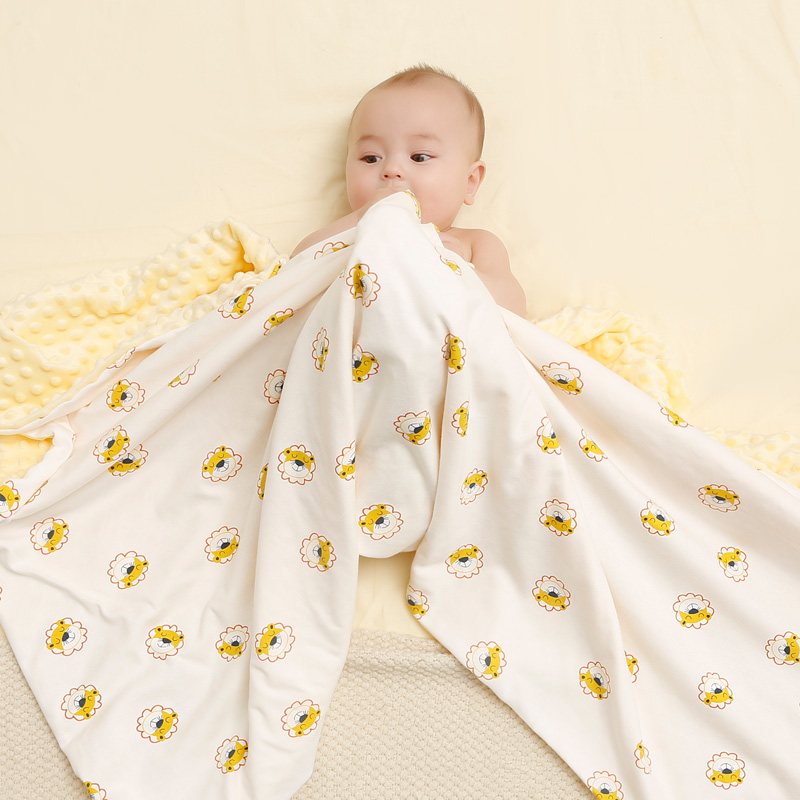
Four fabric families cover most baby blanket ranges: cotton muslin, knitted cotton, waffle or cellular, and plush or sherpa-faced polyester. They differ in warmth, wash behaviour and cost, and a range usually needs only three of them.
The four families
| Family | What it is | Why buyers choose it | Watch |
|---|---|---|---|
| Cotton muslin | Open-weave gauze, 2 or 6 layers | Light, breathable, prints beautifully, softens with washing | Shrinkage and crinkle; sold size must be post-wash |
| Knitted cotton | Jersey or interlock, sometimes brushed | Stretch, warmth without weight, good for stroller blankets | Curl at the edges; needs a stable hem or binding |
| Waffle / cellular | Textured weave with air pockets | Looks substantial, feels light, strong gifting story | Snagging; texture hides print detail |
| Plush / sherpa-faced | Pile surface, usually polyester | Cosy hand-feel at a low unit cost | Fibre naming: sherpa is not wool; pilling and shed |
GSM, layers and what the number means
For gauze, layers are the useful number and GSM is the qualifier: a six-layer 120 gsm gauze is not the same blanket as a six-layer 180 gsm gauze. For knits, GSM alone is a reasonable guide but tells you nothing about stretch recovery. For plush, pile height matters more than weight.
The practical rule: specify both, and specify the finished size after washing. A blanket that arrives 4 cm smaller than the label is a returns problem, not a manufacturing curiosity.
Warmth, and the language that gets you into trouble
Blankets do not carry a TOG rating in the way sleep sacks do, and buyers often try to borrow the vocabulary. The honest description is fabric, weight, size and construction; the dishonest one is a warmth promise the product has not been tested for.
There is also a safety dimension that belongs in the copy rather than the spec: public health guidance in several markets advises against loose bedding in a cot for infants under twelve months. That does not stop blankets being sold — it means the intended use on the label and the product page should be pram, stroller, gifting or toddler, and the wording should be agreed rather than improvised.
Building three SKUs that do not compete
- One lightweight print carrier. Two- or four-layer muslin in a standard size. Cheapest to develop, carries the artwork, sells in gift packs.
- One textured solid. Waffle or cellular in a neutral shade. Sells on texture and looks more expensive than it costs.
- One warm plush or knit. Stroller or winter position, highest unit price. Choose knit if the brand is natural-fibre led, plush if it is price led.
Three is usually enough for a first range. A fourth SKU that sits between the first two cannibalises both and adds a minimum without adding a customer.
How to test a blanket before committing a range
Five checks, all of them cheap, and all of them able to kill a fabric before you commit:
- Wash five times on the cycle you intend to print on the care label, then measure. Dimensional change is the number that decides the sold size.
- Look at the surface after washing, not before. Pilling and shedding appear on plush after two or three cycles, not on the sample you were shown.
- Check the edge. A hem that ripples or a binding that twists is a manufacturing problem that shows up only after wash.
- Test the print, separately from the fabric, for fastness to washing and rubbing.
- Feel it dry and feel it wet. Softness claims are made about the washed product, so judge the washed product.
None of this needs a laboratory to start. It needs one piece of each candidate fabric and a week.
Specification fields
- Fibre and blend percentage, in writing
- Construction: gauze layers, knit type, pile type
- Weight in GSM, and finished size after wash with tolerance
- Edge finish: hem, binding, blanket stitch, or self-edge
- Print method and artwork repeat, if printed
- Label position, care content and packaging format
Six lines. A quote that cannot answer all six is a price, not a specification.
| SKU | Construction | Size | Job in the range |
|---|---|---|---|
| 1. Print carrier | 2-layer cotton muslin, 140 gsm | 120 × 120 cm | Carries the artwork; gift packs |
| 2. Textured solid | Waffle weave, cotton | 100 × 80 cm | Sells on texture; looks dearer than it costs |
| 3. Warm layer | Plush, polyester pile | 75 × 100 cm | Stroller and winter position |
Three SKUs, three different jobs, no two of them competing for the same shelf space. Illustrative values, not a stock product — they show the level of detail a spec sheet needs.
What we can put in front of you
Evidence for the points above, in the form a buyer can check rather than take on trust:
- Five-wash recordDimensions, surface and edge, measured after the cycle printed on the care label.
- Pilling and shedding noteRecorded after two or three washes, because that is when pile fabrics show it.
- Edge after washA hem that ripples or a binding that twists is a making problem, visible only after washing.
From the question to a quote
- 1This guide — the decision behind the question, in the abstract.
- 2Baby blankets — the construction, fabric and size specifications it applies to.
- 3All product lines — if the programme spans more than one line in the same shipment.
- 4Request a quote or a sample — send the fabric, the size set and the expected quantity.
Sources and standards
- US Federal Trade Commission — Threading Your Way Through the Labeling Requirements Under the Textile and Wool Acts (16 CFR Part 303)
- NHS — Safe sleep advice for babies
Links go to the issuing body’s own publication. Where a rule differs by market, the market is named in the text above; nothing here is a statement that a specific product is certified.
Frequently asked questions
What GSM is right for a stroller blanket?
Is sherpa wool?
Can muslin be brushed to make it softer?
Related
Send three things, get a real answer
Fabric or construction direction, the size set you are planning, and the quantity you expect for a first order. Approximate is fine — the point is to quote against your programme rather than against an average. If you already have a reference sample or a spec sheet, send that instead and we will work from it.