
Baby sleep sack supplier for private label and wholesale orders
A baby sleep sack is a sleeveless or long-sleeve wearable blanket worn for sleep instead of a loose blanket. We supply sleep sacks in cotton, jersey, muslin and viscose from bamboo, with TOG, closure and sizing confirmed per style rather than quoted as a range. Orders are either wholesale baby sleep sacks for distributors or private label sleep sacks under the buyer’s own brand — both are quoted per style, never from stock.
Naming first. The same product is a baby sleep sack or wearable blanket in the United States and a baby sleeping bag in the United Kingdom. Footed versions are sold as sleep sack with feet or sleeping bag with legs. We use the vocabulary of the market you sell into, in the quote, the care label and the packaging copy.
What the styles look like
Pieces from the current range, photographed as examples. Prints, colourways and packaging shown are samples of what we run — your own artwork is applied at the sampling stage.
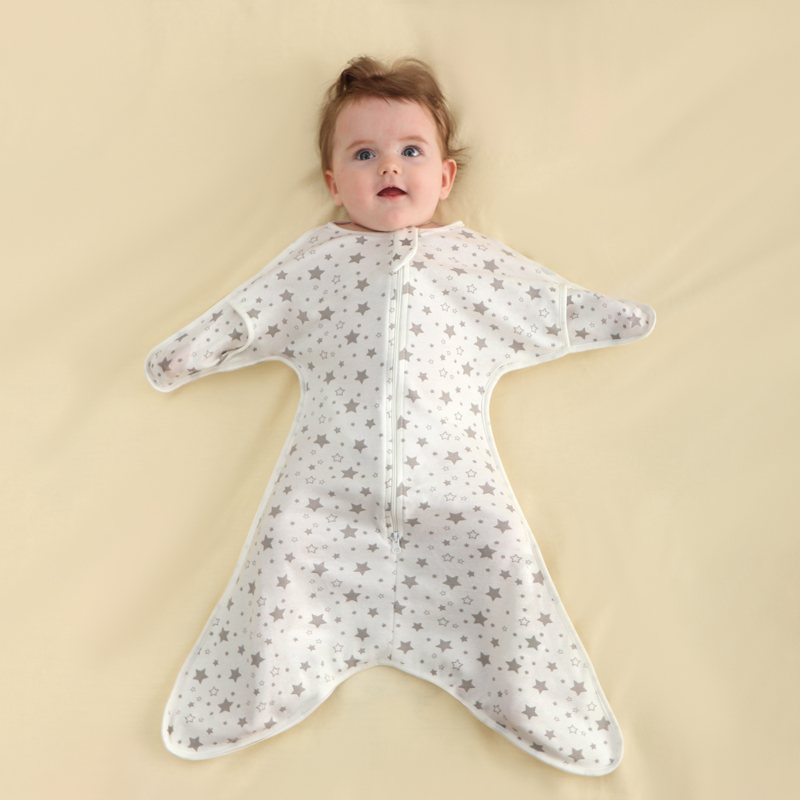
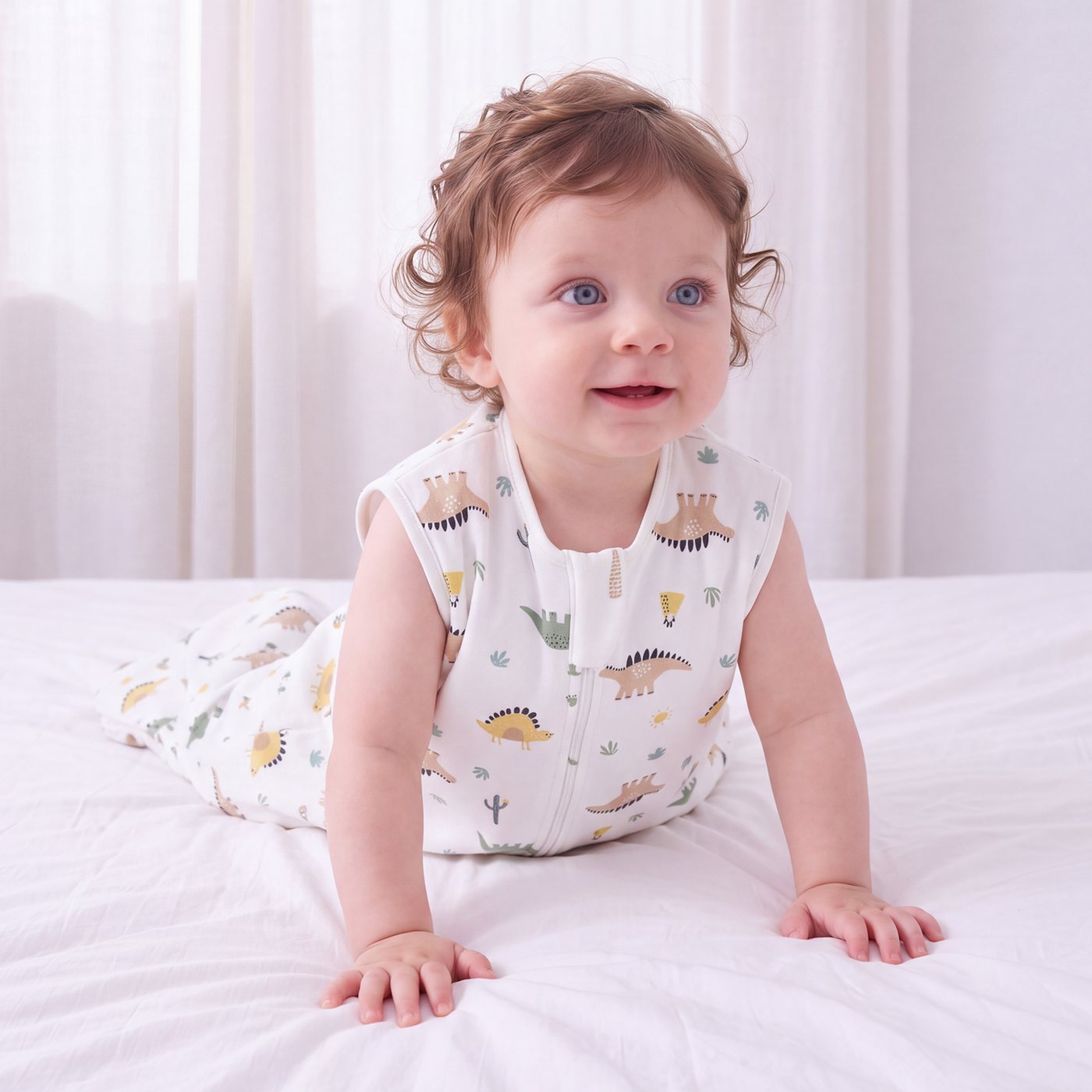
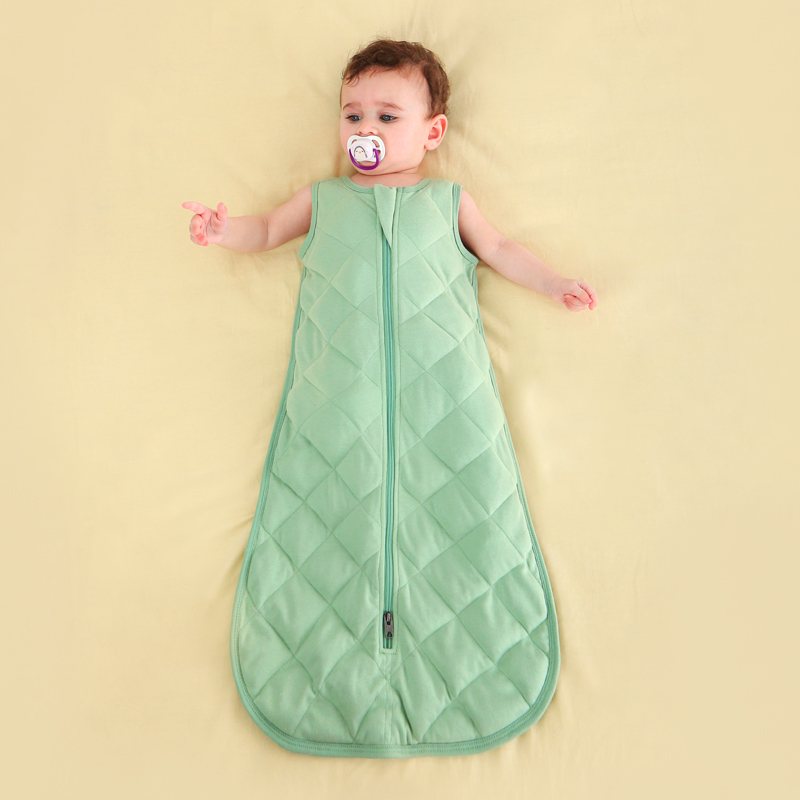
Six constructions we quote against
Structure drives pattern, cost and test scope. Pick the construction before the fabric, not after.
| Construction | What it is for |
|---|---|
| Sleeveless | Standard cot sleep sack. No arm covering, so it layers over sleepwear. |
| Long sleeve | For colder rooms or unheated bedrooms. Sleeve length is a spec point, not an assumption. |
| Detachable sleeve | One body, two warmth levels. Zip-off sleeves must pass an attachment test. |
| Two-way zip | Nappy change without removing the garment. Zip guard at the neck is a spec point. |
| With feet / with legs | For toddlers who walk. Not the same pattern as a footless sack, and priced differently. |
| Transitional | Slimmer fit for the stage after swaddling. Fit and arm access must be stated, not implied. |
TOG ratings
TOG is a measure of thermal resistance. It is a property of the finished garment, so it cannot be inferred from the fibre alone: a cotton muslin shell and a padded cotton shell are both cotton and are not the same TOG. We state the TOG of the style you order and the basis for it.
| Rating | Typical use | Construction note |
|---|---|---|
| 0.5 TOG | Warm rooms, summer, layered over a bodysuit | Lightest construction; often single-layer jersey or muslin. |
| 1.0 TOG | Spring and autumn, most heated homes | The most quoted mid-weight; confirm the actual test for the shell. |
| 2.5 TOG | Winter, unheated rooms, night-time | Requires a padded or multi-layer shell; weight and loft matter. |
| 3.5 TOG | Cold rooms only | Heaviest build; overheating risk rises, so guidance wording matters. |
Fabrics and what to watch
| Fabric | Why buyers choose it | What usually goes wrong |
|---|---|---|
| Cotton jersey | Stretch, soft hand-feel, good for fitted styles | Pilling and shrinkage after wash are the usual failure points. |
| Cotton muslin / double gauze | Breathable, textured, popular for summer | Open weave needs a stable edge finish. |
| Organic cotton | Same construction, different fibre chain | Only claim organic with a transaction certificate covering the batch. |
| Viscose from bamboo | Fluid drape, cool touch | Label as viscose from bamboo, not “bamboo”: fibre naming is regulated in the US. |
| Modal / lyocell | Smooth, low shrinkage | Confirm blend percentage, not just the fibre name. |
| Fleece / sherpa-faced | Loft and warmth without weight | Face fibre and backing are separate spec points. |
Three of these get asked about by name often enough to need more than a table row. They are set out in full below: cotton structures, viscose from bamboo, and what actually produces a 2.5 TOG rating.
Two of those names need evidence before they reach a purchase order. An organic cotton sleep sack is only organic if the fibre chain carries a transaction certificate for that batch; without it the word is a labelling risk, not a selling point. A bamboo sleep sack is a viscose sleep sack: in the United States it has to be described by its fibre name, so the label reads viscose from bamboo, not simply bamboo. We quote both, and we label what the fibre actually is.
Size set
Sizes are quoted as height ranges with a measurement chart. A month label alone is not a fit specification.
| Size | Height | Fit risk |
|---|---|---|
| Newborn | up to 56 cm | Nappy-change access matters more than length. |
| 0–6 months | 56–68 cm | Neck opening and armhole are the fit risks. |
| 6–12 months | 68–80 cm | Most common first order size band. |
| 12–18 months | 80–86 cm | Sleeveless styles start to gap at the shoulder. |
| 18–24 months | 86–92 cm | Footed versions become relevant. |
| 2–3 years | 92–98 cm | Toe room and zip length are the constraints. |
Cotton sleep sacks
Cotton is the default shell for a sleep sack, but “cotton” is not a specification. Jersey, muslin and waffle are all cotton and behave differently in stretch, warmth and wash.
Three cotton structures, three different products
| Structure | What it gives you | Where it fails |
|---|---|---|
| Single jersey | Stretch and a soft hand-feel; the cheapest way to a fitted sack | Pilling and lengthwise shrinkage after repeated washing |
| Interlock | Two-sided, more dimensional stability than jersey | Higher fabric cost; hand-feel is firmer |
| Muslin / double gauze | Open weave, breathable, textured; the summer story | Edge fraying; the seam is the first thing to go |
| Waffle | Visual loft without weight; reads as warmer at retail | Snagging, and loft that collapses unevenly after wash |
Gram weight (gsm) sits on top of all four. Two jersey sacks at 160 gsm and 220 gsm are the same structure and a different product, in warmth, drape and price. We quote gsm with a tolerance band, because a fabric delivered 8% light is a different garment.
- Ask for the wash test, not the shrink claim. Cotton shrinks; the only useful number is the one measured on that fabric after the wash cycle you will print on the care label.
- Organic is a fibre chain, not a construction. An organic cotton jersey sack is made exactly like a conventional one. The claim needs a transaction certificate covering the batch, not a logo on the packaging.
- Print changes the hand. A large placement print on jersey stiffens the panel it covers. If the print is the product, sample the print, not the greige fabric.
Bamboo viscose sleep sacks
Viscose from bamboo is a fibre, not a finish. It drapes more than cotton and takes dye differently, and in the US it has to be labelled by its fibre name rather than as “bamboo”.
Cotton and viscose from bamboo, side by side
| Property | Cotton | Viscose from bamboo |
|---|---|---|
| Drape | Holds shape; reads as structured | Fluid; hugs the body |
| Touch | Dry, familiar | Cool and smooth against skin |
| Wet strength | Stronger when wet | Weaker when wet; handle with care in wash and in the sewing room |
| Pilling | Moderate, depends on the knit | Higher risk on lightweight knits |
| Dye | Takes dye evenly, predictable | Deep shades are achievable but shade control across lots needs agreeing up front |
| Cost position | Baseline | Above cotton at the same gsm |
The labelling point that matters most. In the United States, a garment made from bamboo-derived viscose must be described by its fibre name — viscose from bamboo or rayon from bamboo — not simply as “bamboo”. We label to the rule. We also do not put antibacterial, hypoallergenic or “natural” claims on a viscose garment, because the fibre has been through a chemical process and the claim would not survive a challenge.
Where it earns its price: a brand whose position is softness and temperature comfort, selling at a premium, where the hand-feel is the reason someone picks the product up. Where it does not: a value range competing on price per unit, or a print-led range where the artwork is doing the selling.
2.5 TOG sleep sacks
2.5 TOG is the winter weight most buyers ask for by number. The number is a property of the finished garment, so it depends on fill weight and loft, not on the fibre name.
What actually produces 2.5 TOG
Three variables move the number: the fill (its weight and its loft), the number of layers, and the shell. A single-layer jersey sack cannot reach 2.5 TOG by being made of heavier jersey; the warmth comes from trapped air, which means fill or a multi-layer build.
| Build | How it gets there | What goes wrong |
|---|---|---|
| Quilted, filled | Stitched channels holding a wadding layer | Cold spots along the stitch lines; fill migration if channels are too wide |
| Padded, bagged | Loose fill between shell and lining | Fill settles to the bottom after washing unless it is anchored |
| Multi-layer knit | Two or three knitted layers joined at the edges | Air pockets collapse after wash if the layers are not tacked |
This is why a TOG claim has to travel with the build. If you change the fill weight, the channel width or the shell, you have changed the product, and the number on the packaging has to be re-established rather than carried over.
- 2.5 TOG is a winter garment. The guidance printed with it should name a room-temperature band and the layers worn underneath, and the three have to agree. A 2.5 TOG sack sold with “wear over a sleepsuit” and a 24 °C recommendation is internally inconsistent.
- Warmer is not safer. Overheating is the risk this category is regulated around, which is why we do not describe a higher TOG as better, and why we do not offer weighted versions at all.
- Armholes and no hood. A heavy winter sack is exactly the product where a hood gets added for looks. The UK OPSS alert of October 2026 covers that combination.
Three things that are not negotiable
- No hood, and armholes are required. The UK OPSS safety alert of October 2026 concerns sleeping bags with a hood or without armholes, citing overheating and suffocation risk. Sleep sacks for unsupervised cot sleep should follow that guidance.
- Stop swaddling at the first sign of rolling. This is standard paediatric advice and belongs in the care instructions, not only in the marketing copy.
- Attachment security. Zip pullers, poppers and trims are checked as small parts. A recall for a detachable zip puller is a batch-level event, which is why we keep batch traceability on every run.
What is specified on the order, and what varies
Every line below appears on the specification you receive with the quote. The third column is the honest part: what changes from style to style, so you know which points to fix and which to leave open.
| Item | What we specify | Where it varies |
|---|---|---|
| Shell fibre | Cotton jersey, interlock, muslin / double gauze, viscose from bamboo, or a stated blend | Per style; the blend is stated as a percentage, not as a fibre name |
| Fabric weight | Quoted in gsm with a tolerance band | Per fabric; two jersey shells at different gsm are different products |
| TOG | 0.5, 1.0, 2.5 or 3.5, stated against the build | Per style, never as a range across a collection |
| Fill and loft | None, or a stated wadding weight between shell and lining | Only on 2.5 TOG and above; fill weight is quoted, not implied |
| Closure | Single zip, two-way zip, shoulder poppers or side opening | Per style; a two-way zip needs a different pattern, not a longer zip |
| Zip guard | Chin guard and a non-detachable puller | Every style; a detachable puller is a small-parts hazard |
| Sleeve and foot | Sleeveless, long sleeve, detachable sleeve; footless, footed or with legs | Per style; footed patterns are graded separately |
| Armhole and hood | Armholes required, no hood | Every style for unsupervised cot sleep — not an option |
| Size band | Height-based, 56 cm to 98 cm, quoted as points of measure | Per size set; a month label alone is not a specification |
| Labels | Woven main label, printed care and composition label, size flag | Per artwork; wording checked against the destination market |
If your own tech pack uses different points of measure, send it. We work from your document and note where it differs from ours, rather than silently translating it.
What can carry your brand
Private label, custom print and custom development are three different jobs with three different minimums. The third column says which one you are actually buying into.
| Element | What we can do | What drives the minimum |
|---|---|---|
| Digital or rotary, all-over or placement, with an agreed colour standard | Print minimum per fabric and per colourway | |
| Colour | Stock shade, or dyed to a colour standard you supply | Dye lot minimum |
| Labels | Woven main label, printed care and composition label, size flag | Label run, usually the smallest driver |
| Packaging | Polybag, header card, belly band, printed box | Packaging print run |
| Pattern | Sleeve, closure, foot, quilt pattern and size set | Pattern development and sampling |
How the minimum is calculated
We do not publish one headline minimum, because a single number is always the easiest combination rather than yours. These are the rules the number comes from.
| Question | How it works |
|---|---|
| How the minimum is calculated | The order minimum is the largest of four: the fabric run, the print or dye lot, the style minimum per size and colour, and the packaging print run. We give all four separately, so you can see which one is binding before you commit. |
| How colours and sizes combine | A minimum applies per style-and-colour combination, not to the order as a whole. Four sizes in three colourways is twelve combinations, and the arithmetic is units divided by twelve. |
| Mixing within one order | Styles sharing a shell fabric and a print can be combined against that fabric minimum. Different colourways, different shells or a printed box each carry their own minimum. |
| Repeat orders | A repeat against an approved sample and an existing fabric is quoted against a lower minimum than a first order. The repeat minimum is stated in the first quote, not held back. |
| Price breaks | Priced at quantity break points across fabric, making, trims, packing and testing as separate lines, so two quotes can be compared on the same basis. |
What you send, what comes back
Sampling is where a specification stops being a document. This is the sequence, and what each stage settles.
| Stage | What happens |
|---|---|
| What to send | Style or reference sample, target TOG and construction, size set, artwork, and the destination market. |
| What we send back | A specification sheet with points of measure and tolerances, the four minimums, and a sampling plan with the stages named. |
| What the sample settles | Fabric hand-feel, shell and lining combination, zip and guard, neck opening and armhole, and the fit at the smallest size. |
| Cost and timing | Sample cost, whether it is credited against a bulk order, and the time at each stage are stated in the quote. We do not publish a headline lead time, because it is set by fabric, print and the size of the run. |
| Sealed sample | Bulk is made against a signed sealed sample. The seal defines the reference for colour, measurement and trims; a change after sealing is a new sample. |
Lead time is quoted per stage — sampling, material, bulk, shipping — rather than as one figure that hides where the waiting is. The same applies to sample cost: it is stated with any credit against bulk.
What a document covers, and what it does not
A test report is only useful if you know its boundary. The third column is the boundary, written the way we would explain it on a call.
| Document | Covers | Does not cover |
|---|---|---|
| In-house inspection record | Measurement check against points of measure, visual defect check, and attachment pull test on zip and poppers, per batch | Our own record, not a third-party report |
| Third-party test report | The standards and clauses named in the report, for the style and batch that was submitted | Does not automatically cover other colourways, other sizes or a changed shell |
| Fibre composition statement | The composition of the batch as labelled | A declaration, not a certification |
| Certificate (if held) | Only the products and processes listed on that certificate, within its validity period | Never presented as covering the whole range |
| Safety documents by market | The route that applies to the style and market, confirmed in writing before bulk | Issued by the testing body, not by us; we do not self-declare a standard |
Questions buyers ask
What is a baby sleep sack?
What is the difference between a sleep sack and a swaddle?
Which TOG should I order?
Should the sleep sack have a hood?
Can you do a two-way zip?
Are your sleep sacks weighted?
How is sizing decided?
Can I mix TOG values and prints in one order?
What is the minimum order for wholesale baby sleep sacks?
Do you supply both wholesale and private label sleep sacks?
What buyers usually add to the same order
Most programmes do not stop at one product. The swaddle covers the newborn stage before a sleep sack is used, and the blanket carries the same print into a gift set or a stroller accessory. Because the fabric and the artwork are shared, the second and third products usually carry the lowest unit cost in the container.
Muslin swaddle blankets
Open-weave cotton muslin in 2 and 6 layers, plus structured swaddle wraps. Same print as the sleep sack, different construction.
View muslin swaddles →ExtensionBaby blankets
Muslin, knitted cotton, waffle and cellular blankets for retail, gifting and stroller use. Fabric and finish do the selling here.
View baby blankets →Each component keeps its own pattern, minimum and test scope. The shared part is the fabric, the artwork and the carton plan.
Sourcing sleep sacks for a season?
Send the construction, TOG, size set, quantity and destination. We will come back with a specification, a sampling plan and price breaks that match your volumes.