
Choosing TOG ratings for a baby sleep sack collection
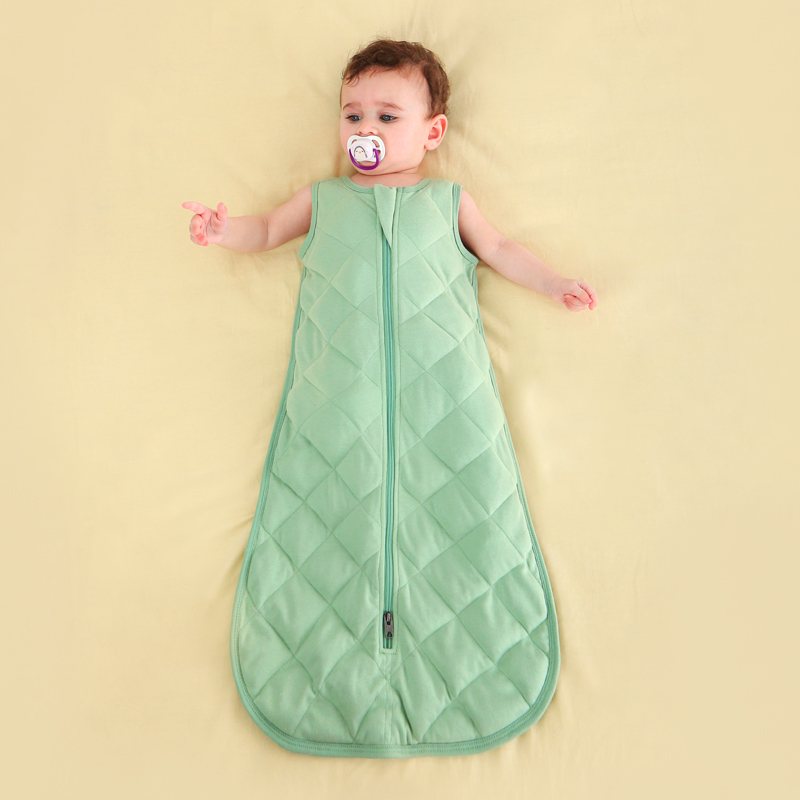
TOG measures thermal resistance: the higher the number, the warmer the garment. It is a property of the finished product, not of the fibre, so two cotton sleep sacks can carry very different TOG values. A supplier should be able to state the TOG and the basis for it for each style.
What TOG is not
TOG is not a room-temperature instruction, and it is not a fibre property. A retailer may publish a table linking TOG to room temperature, which is a helpful heuristic for parents, but the number on the product is a measurement of that garment.
This is why “our cotton sleep sack is 2.5 TOG” is not a statement you can carry across a range. A muslin shell and a quilted shell can both be cotton and differ by two TOG steps.
The common ratings and what changes
| TOG | Typical season | What changes in construction |
|---|---|---|
| 0.5 | Summer, warm rooms | Single layer, often jersey or muslin, no wadding |
| 1.0 | Spring and autumn | Double layer or light interlining |
| 2.5 | Winter, unheated rooms | Padded shell or multi-layer with loft |
| 3.5 | Cold rooms only | Heaviest build; overheating guidance becomes critical |
In the UK, TOG is a familiar retail filter and shoppers search by it directly. In the US it is less familiar to consumers, which affects how much of the product page should be spent explaining it.
What a supplier should be able to tell you
- The TOG of the specific style, not a range across the collection
- The construction basis: layers, wadding, shell fabric
- Whether the value is tested or calculated, and by whom
- How the care instructions interact with the rating over time
“Tested” and “calculated” are not the same claim, and a buyer who publishes a calculated value as tested is exposed if the product is checked.
Planning the ladder for a collection
| Rating | What the build usually looks like | Where it sits in a range |
|---|---|---|
| 0.5 TOG | Single jersey or light muslin shell, no wadding | Summer and warm-room SKU; lowest unit cost |
| 1.0 TOG | Jersey shell with a light lining | Transitional; often the volume SKU |
| 2.5 TOG | Quilted shell with wadding | Core winter SKU and the most searched rating |
| 3.5 TOG | Heavier wadding, often with sleeves | Cold-room position; highest cost and narrowest size band |
Most first ranges run two SKUs: 1.0 and 2.5. Add 0.5 only if the market has a genuine warm-room season, and treat 3.5 as a later addition — it is the most expensive to build and the easiest to get wrong on sizing because it is worn over the most clothing.
Verifying the rating on the finished product
Thermal resistance is measured on the finished garment, so the certificate, the report or the test has to refer to that build. Three questions make the difference between a rating and a claim: which method was used, which size was tested, and whether wadding or lining changed after the test.
If only the smallest size was tested, the larger sizes are not automatically covered — the surface area to volume ratio changes with size. We state the basis for the rating on the quote, including the size tested, so the number can be defended if a buyer asks.
The safety context buyers should know
In October 2026 the UK Office for Product Safety and Standards issued an alert on baby sleeping bags, citing overheating and suffocation risk where a bag has a hood or no armholes. Warmer ratings raise the stakes on this: a 3.5 TOG bag with a hood in a heated room is the scenario the guidance is trying to prevent.
The same alert states that dedicated swaddle products are outside its scope, which is a reason to keep swaddles and sleep sacks as separate product types with separate descriptions — not a reason to treat swaddles as unregulated.
| SKU | Build | Size set | Sold as |
|---|---|---|---|
| 1.0 TOG | Jersey shell + light lining, no wadding | 0–6, 6–12, 12–18 months | Transitional; the volume SKU |
| 2.5 TOG | Quilted shell + 120 gsm wadding | 0–6, 6–12, 12–18 months | Winter core |
Two builds, one pattern, one print. The 3.5 TOG is deliberately absent: it costs most to build, is worn over the most clothing, and is the easiest to get wrong on sizing. Illustrative values, not a stock product — they show the level of detail a spec sheet needs.
What we can put in front of you
Evidence for the points above, in the form a buyer can check rather than take on trust:
- TOG basis, per styleWhich method, which size was tested, and whether wadding or lining changed afterwards.
- Construction recordLayer count and wadding weight per SKU, so the rating can be traced to a build rather than a slogan.
- Care interactionWhat the rating assumes about washing and drying, because loft changes over a product’s life.
From the question to a quote
- 1This guide — the decision behind the question, in the abstract.
- 2Baby sleep sacks — the construction, fabric and size specifications it applies to.
- 3All product lines — if the programme spans more than one line in the same shipment.
- 4Request a quote or a sample — send the fabric, the size set and the expected quantity.
Sources and standards
- OPSS — Product Safety Alert: Baby Sleeping Bags (PSA9), 1 October 2026
- NHS — Safe sleep advice for babies
Links go to the issuing body’s own publication. Where a rule differs by market, the market is named in the text above; nothing here is a statement that a specific product is certified.
Frequently asked questions
Is higher TOG always better for winter?
Can TOG be claimed from the fabric alone?
Do US buyers search by TOG?
Related
Send three things, get a real answer
Fabric or construction direction, the size set you are planning, and the quantity you expect for a first order. Approximate is fine — the point is to quote against your programme rather than against an average. If you already have a reference sample or a spec sheet, send that instead and we will work from it.