
Custom muslin swaddle blankets: a buyer’s guide
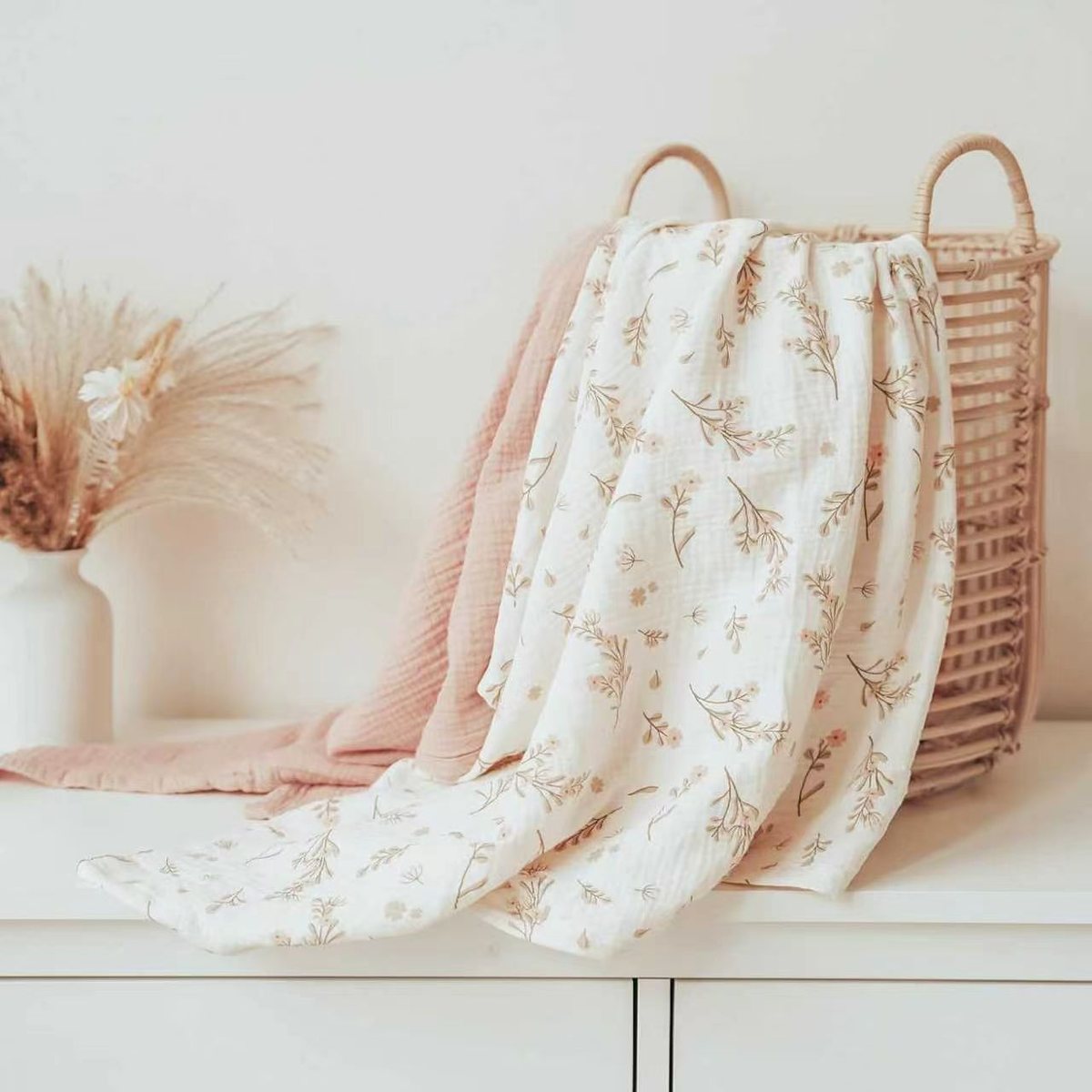
A muslin swaddle is specified by four things: size, layer count, weave and print method. Size and layers decide the use case; weave decides the hand-feel; print method decides both the look and how the fabric behaves after washing. It is written for buyers specifying a private label swaddle or a gift-set component.
Size, and what it is for
| Size | Typical use | Procurement note |
|---|---|---|
| 100 x 100 cm | Hospital packs, newborn gift sets | Less fabric, lower unit cost, narrow print area |
| 120 x 120 cm | The standard retail swaddle | The size most buyers mean when they say swaddle blanket |
| 140 x 140 cm and above | Larger babies, multi-use blankets | Fabric consumption rises quickly; check the print repeat |
A size quoted without a tolerance is not a specification. Muslin is a gauze, and gauze moves: ask for the cut size, the finished size after washing, and the permitted tolerance on both.
Layer count is a product decision, not an upgrade
Two layers is the general-purpose swaddle; six layers become a blanket. Each additional layer adds fabric, adds a joining operation, and changes how the product drapes and how long it takes to dry.
Buyers often ask for six layers because it sounds more substantial. In practice a six-layer muslin is a different product from a swaddle — warmer, heavier, slower to dry — and it belongs in the blanket range rather than the swaddle range. Specifying it as a swaddle usually produces a product that is neither.
Weave and yarn
Open-weave gauze is what makes muslin muslin: the openness gives it the texture and the quick-drying behaviour that buyers are actually paying for. Yarn count and density determine how open the weave is, and therefore how the printed artwork reads. A fine, tight gauze prints sharply and feels flatter; a looser weave looks softer and loses detail.
Ask for the fabric weight in GSM alongside the layer count. Layers without GSM is half a specification, in the same way that GSM without layer count is.
Print methods and what they do to the hand
| Method | Best for | Watch |
|---|---|---|
| Digital print | Small runs, many colours, photographic artwork | Higher cost per metre; check wash fastness |
| Rotary screen | Longer runs, repeating designs | Setup per colourway; repeat length must suit the size |
| Discharge or burnout | Tonal, soft-hand effects | Fabric-dependent; test before committing a range |
| Embroidery or appliqué | Gift and premium packs | Adds an operation and a minimum of its own |
Heavy ink coverage stiffens a gauze. On a product whose whole appeal is softness, that is a real trade-off: the artwork that looks best in a mock-up is not always the artwork that feels best in the hand. Print a strike-off and wash it before approving the range.
Shrinkage, and why the first wash is a purchasing issue
Cotton gauze shrinks, and it crinkles — that crinkle is part of the product. The purchasing problem is not that it shrinks, it is whether the size you sell is the size before or after washing. If the finished size is quoted before washing and sold after it, the customer receives a smaller product than the label claims, and the returns follow.
Ask for the wash-test result on the fabric quoted: dimensional change after the stated wash cycle, and whether the sample was pre-washed before cutting.
Packing, where gift sets are won
- Belly band — cheapest way to carry a brand; needs its own print run.
- Header card — good for hanging retail, weak for gifting.
- Printed box — the gift-set default; usually the binding minimum on a small order.
- Multi-pack — two or three pieces in one pack raises the unit value and the fabric minimum.
Packaging is specified last but priced first: on a first order it is often the line that decides whether the programme is economic at all.
| Field | Example value | Why it is specified this way |
|---|---|---|
| Cut size | 128 × 128 cm | Allows for weave shrinkage before finishing |
| Sold size | 120 × 120 cm after wash | The customer measures the washed product |
| Tolerance | ±3% on both dimensions | Gauze moves; zero tolerance is not producible |
| Weight | 120 gsm, two layers | Layers without GSM is half a specification |
| Edge | Double-fold hem, mitred corners | The corner is where cheap gauze fails first |
| Digital, one placement | Small runs without a rotary set-up |
Illustrative values, not a stock product — they show the level of detail a spec sheet needs.
What we can put in front of you
Evidence for the points above, in the form a buyer can check rather than take on trust:
- Wash recordCut size, washed size and the cycle used, on the fabric quoted.
- Strike-off, washedPrint approved on gauze and then washed, because heavy ink stiffens an open weave.
- Layer cross-sectionA cut sample showing how the layers are joined, which is where a two-layer product separates in use.
- Points of measureFinished dimensions with tolerance, issued before the sample is cut.
From the question to a quote
- 1This guide — the decision behind the question, in the abstract.
- 2Muslin swaddle blankets — the construction, fabric and size specifications it applies to.
- 3All product lines — if the programme spans more than one line in the same shipment.
- 4Request a quote or a sample — send the fabric, the size set and the expected quantity.
Sources and standards
Links go to the issuing body’s own publication. Where a rule differs by market, the market is named in the text above; nothing here is a statement that a specific product is certified.
Frequently asked questions
One layer or two for a first range?
Why does our muslin arrive smaller than the label?
Does printing make muslin stiffer?
Related
Send three things, get a real answer
Fabric or construction direction, the size set you are planning, and the quantity you expect for a first order. Approximate is fine — the point is to quote against your programme rather than against an average. If you already have a reference sample or a spec sheet, send that instead and we will work from it.