
Baby bib supplier for bandana, drool and teething ranges
A baby bib is specified by style, face fabric, backing and closure — and the closure is a small-parts decision, not a styling one. We supply bandana bibs, drool bibs, teething bibs, muslin drool cloths and waterproof-backed styles in cotton terry and muslin. Orders are wholesale baby bibs under your own brand, packed flat or in multipacks.
What the styles look like
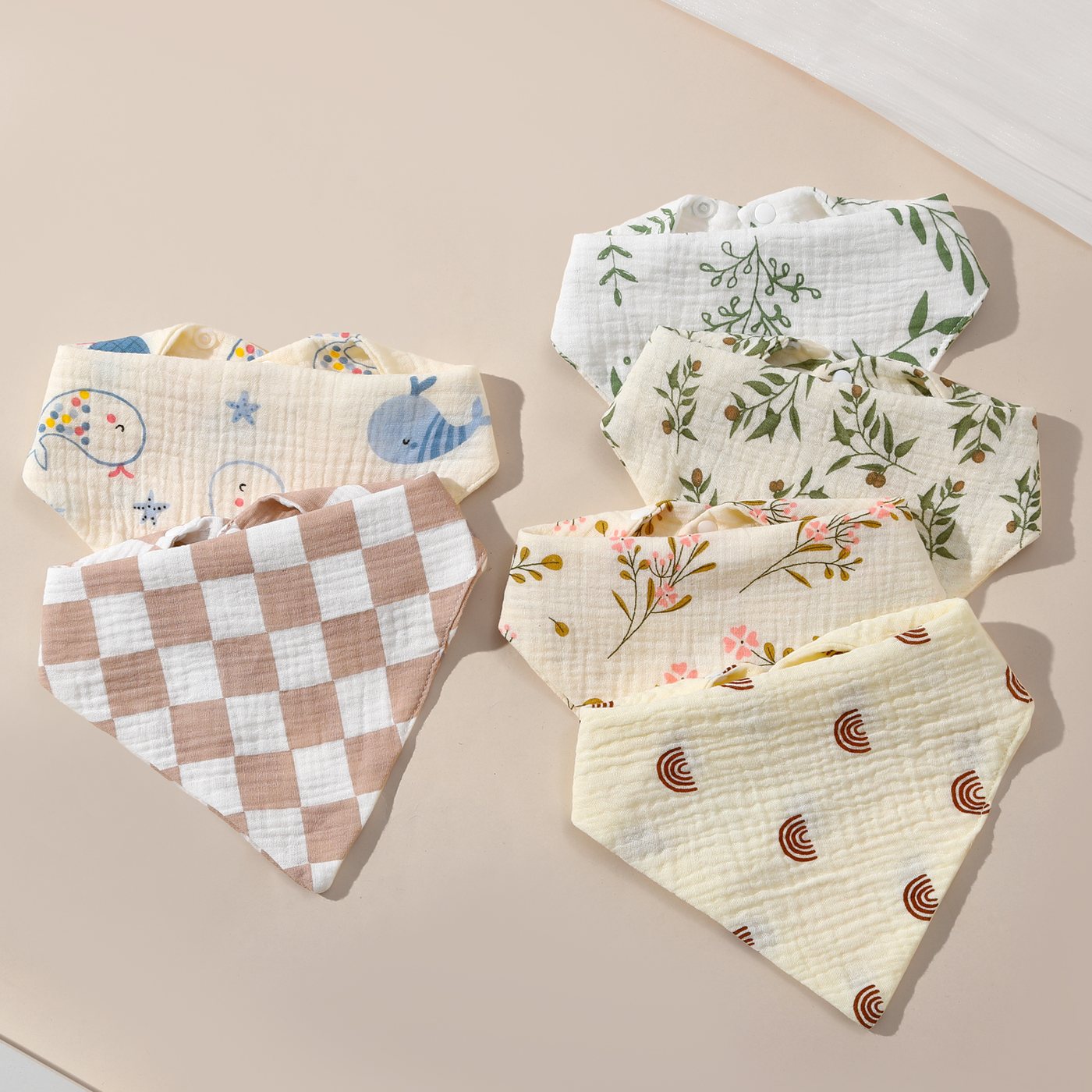
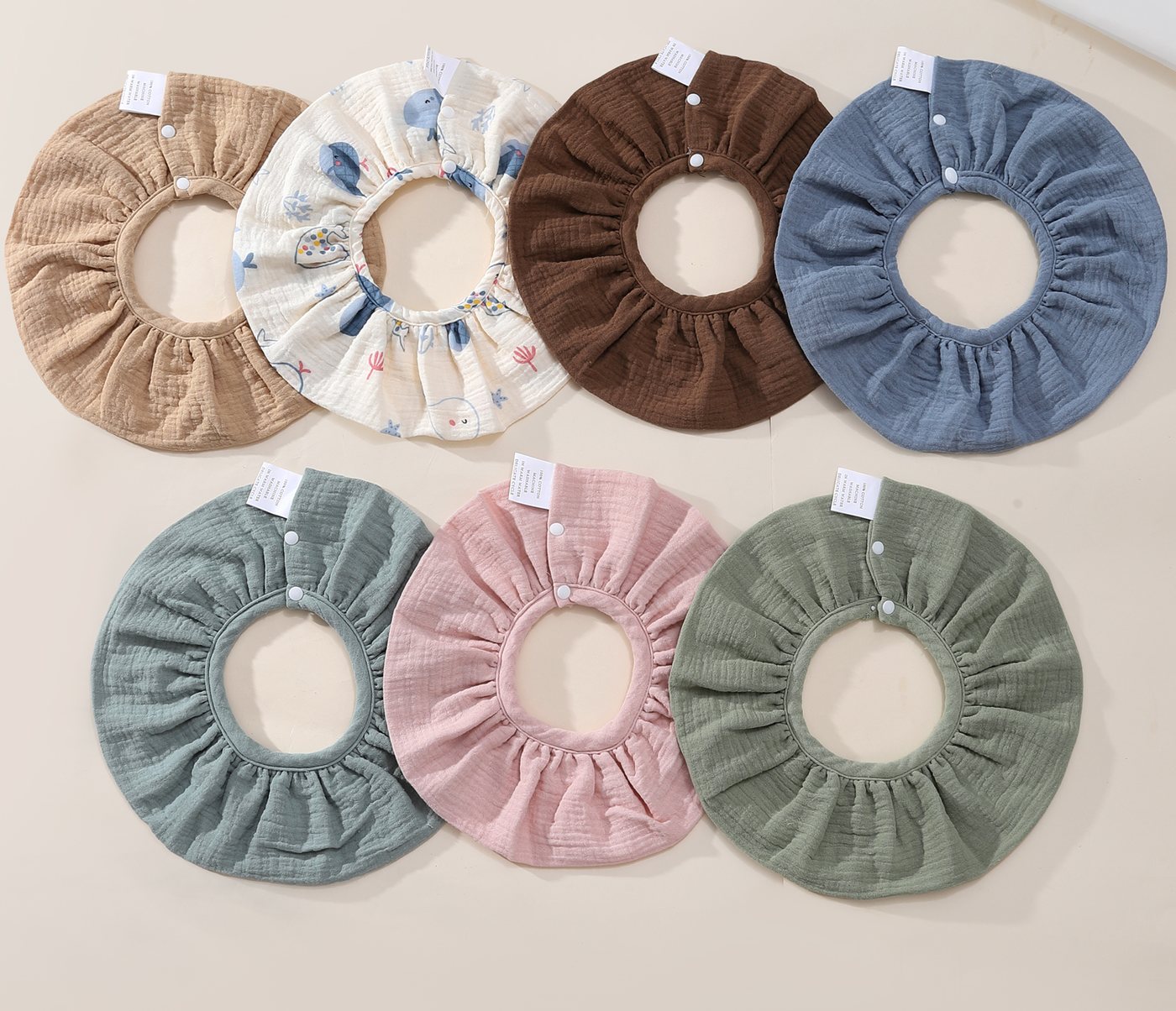
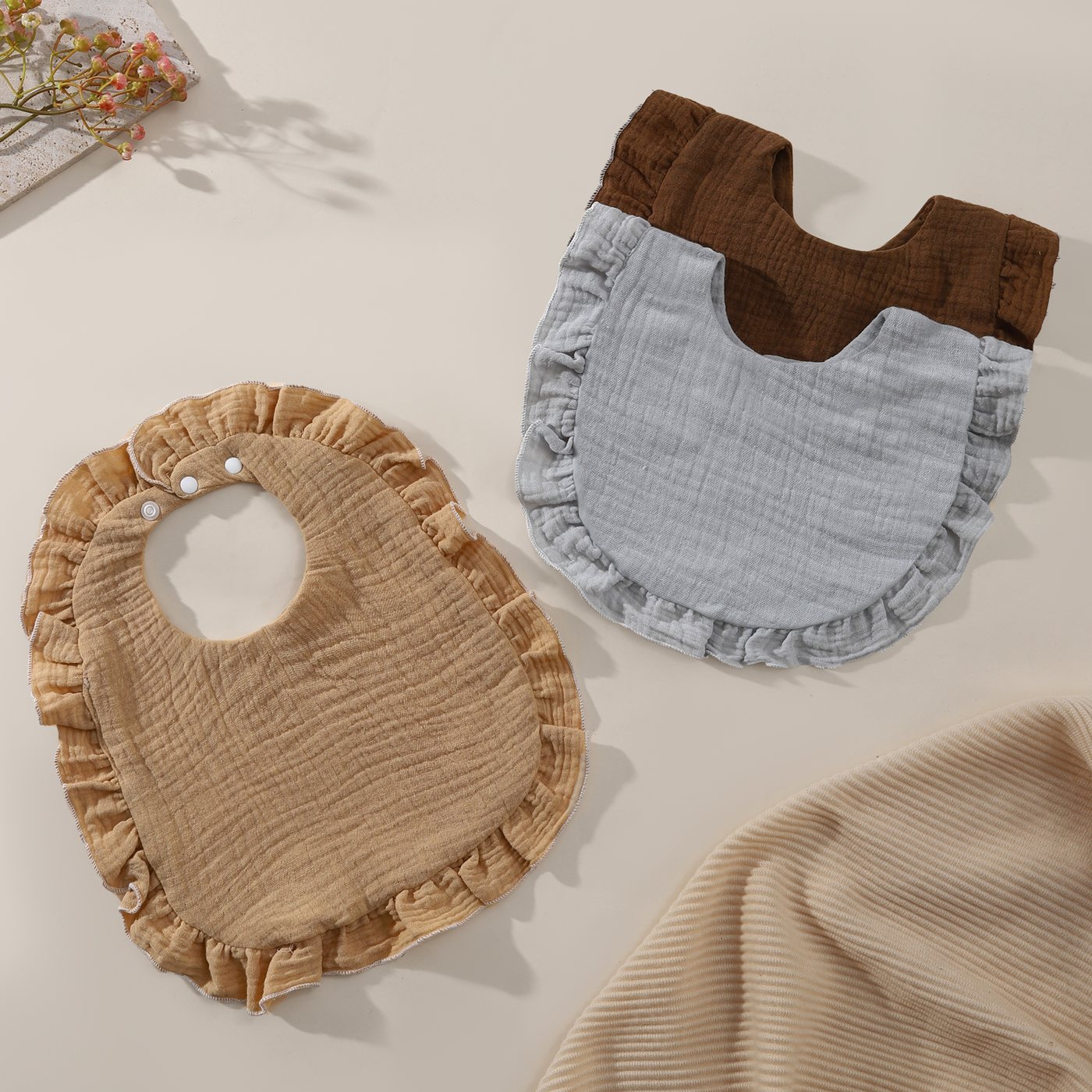
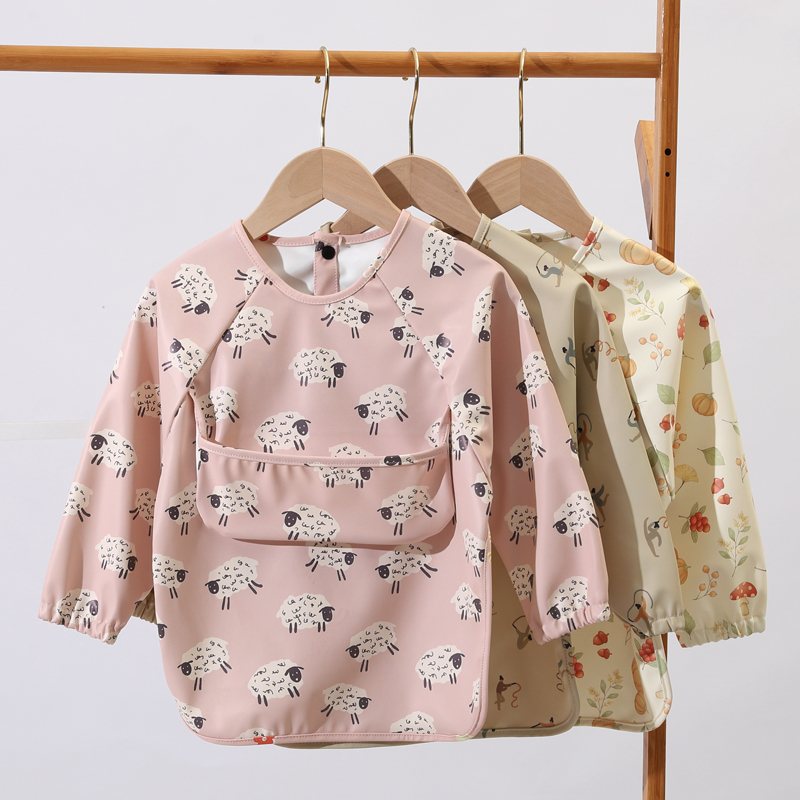
Pieces from the current range, photographed as examples. Prints, colourways and packaging shown are samples of what we run — your own artwork is applied at the sampling stage.
Style sells the bib; construction decides the returns
Bibs look simple and are specified like anything else: the face fabric, the backing, the closure and the edge each change how the product behaves after ten washes.
| Style | Construction | Where it sells |
|---|---|---|
| Bandana bib | Bandana cut, cotton terry or muslin face | Style-led drool ranges; prints sell it |
| Drool bib | Round or classic cut, terry face, optional waterproof backing | Everyday feeding and teething ranges |
| Teething bib | Bib with an attached silicone teether or crinkle part | The attachment is its own small-parts review |
| 360-degree rotating bib | Two-layer bib that pivots on its closure to reposition the clean face | The pivot point is checked as an attachment, not just a snap |
| Muslin drool cloth | Flat 2, 4 or 6 layer muslin squares, matching the swaddle constructions | Multipacks and muslin programmes; shares fabric with swaddles |
| Waterproof baby bib | Laminated backing layer under a terry or muslin face | Weaning and mealtime; wash care wording changes |
What to fix before sampling
| Point | Why it matters |
|---|---|
| Neck opening | Checked against the smallest intended age; a range usually spans 0 to 24 months across 2 or 3 neck sizes, and a generous neck sells to a wider age band |
| Face fabric and weight | Absorbency is verified in a wash test, not assumed from gsm |
| Backing | A waterproof layer changes wash care wording and the recycling claim |
| Closure | Snaps are graded by pull strength and reviewed as small parts; hook-and-loop wears out first |
| Edge finish | Terry and muslin fail at the edge first; bound edges cost more and last longer |
| Packing | Multipack banding drives the print minimum more than the bib fabric does |
Bibs are the lowest-risk textile in a baby range and the easiest one to widen a programme with, because they share fabric with burp cloths, washcloths and muslin covers.
Care wording follows the construction: cotton terry and muslin are usually labelled for a 30 to 40°C wash, while a waterproof-backed bib drops to 30°C and air drying. A bib has no thermal rating to quote — unlike the 0.5 to 3.5 TOG sleep sack range, the numbers that sell it are layers, absorbency and pack count.
What is specified on the order, and what varies
Every line below appears on the specification you receive with the quote. The third column is the honest part: what changes from style to style, so you know which points to fix and which to leave open.
| Item | What we specify | Where it varies |
|---|---|---|
| Style | Bandana bib, traditional drool bib with pocket, teething bib with an attached teether, or a flat muslin drool cloth | Per style; a bandana and a round bib are different patterns |
| Fibre and face | Cotton terry, cotton muslin (single or multi-layer), or a stated blend | Per style; the blend is stated as percentages |
| Waterproof backing | A laminated backing layer where the programme needs it, specified by material and lamination type | Per style; the backing changes wash care and the compost/recycling claim |
| Fabric weight | Quoted in gsm | Per fabric; absorbency is verified in a wash test, not assumed from gsm alone |
| Closure | Snap studs, hook-and-loop, or a tie | Per style; snaps are graded by pull strength and are a small-parts review point |
| Size | Neck opening, drop length and width, quoted as points of measure | Per size set; the neck opening is checked against the smallest intended age |
| Edge finish | Bound edge, overlock, or a turned-and-stitched hem | Per fabric; terry and muslin fail at the edge first |
| Packing | Polybag, header card, or a multi-pack with printed band | Per artwork; multi-pack banding drives the print minimum |
| Labels | Woven or printed main label, care and composition label | Per artwork; wording checked against the destination market |
If your own tech pack uses different points of measure, send it. We work from your document and note where it differs from ours, rather than silently translating it.
What can carry your brand
Private label, custom print and custom development are three different jobs with three different minimums. The third column says which one you are actually buying into.
| Element | What we can do | What drives the minimum |
|---|---|---|
| Digital or rotary, all-over or placement; woven label option for plain styles | Print minimum per artwork and per colourway | |
| Colour | Stock terry or muslin shade, or dyed to a colour standard | Dye lot minimum per colour |
| Backing | Waterproof laminated backing where the programme needs it | Lamination lot minimum; adds a sample stage |
| Hardware | Snap studs or hook-and-loop, chosen with you | Hardware lot minimum; snaps are a small-parts review point |
| Labels | Woven or printed main label, care and composition label | Label run |
| Packaging | Polybag, header card, or a multi-pack with printed band | Multi-pack banding drives the print minimum |
How the minimum is calculated
We do not publish one headline minimum, because a single number is always the easiest combination rather than yours. These are the rules the number comes from.
| Question | How it works |
|---|---|
| How the minimum is calculated | Largest of: fabric run, print minimum per artwork and colourway, style minimum, snap or hook-and-loop hardware minimum, and packaging print run. |
| How colours and styles combine | Each artwork is its own print minimum. Plain-colour bibs mix more freely than printed ones. |
| Mixing within one order | Bibs share terry and muslin fabrics with burp cloths, washcloths or covers in the same programme, which usually lowers the fabric minimum of the second product. |
| Repeat orders | A repeat on an approved sample and existing fabric carries a lower minimum; stated in the first quote. |
| Price breaks | Fabric, backing, hardware, making, packing and testing are quoted as separate lines with quantity breaks. |
What you send, what comes back
Sampling is where a specification stops being a document. This is the sequence, and what each stage settles.
| Stage | What happens |
|---|---|
| What to send | A reference bib or photos, style and size direction, the backing decision (waterproof or not), artwork if printed, and the destination market. |
| What we send back | A specification sheet with neck opening and drop length, closure type and pull rating, and the absorbency test result. |
| What the sample settles | Absorbency and dry-back time, closure pull strength, edge integrity after a wash cycle, and print hand-feel. |
| Cost and timing | Sample cost and stage timing stated in the quote; a waterproof-backed style adds a lamination sample stage. |
| Sealed sample | Bulk follows the sealed sample for backing, closure and hem. |
Lead time is quoted per stage — sampling, material, bulk, shipping — rather than as one figure that hides where the waiting is. The same applies to sample cost: it is stated with any credit against bulk.
What a document covers, and what it does not
A test report is only useful if you know its boundary. The third column is the boundary, written the way we would explain it on a call.
| Document | Covers | Does not cover |
|---|---|---|
| In-house inspection record | Absorbency check, snap pull test, size after wash, edge integrity, per batch | Our own record, not a third-party report |
| Fibre composition statement | Face and backing composition as labelled | A declaration, not a certification |
| Third-party test report | The standards named in the report, for the submitted style | Does not cover a changed backing or closure |
| Small-parts review | Snap and teether attachment pull check, per style | Any attached teether is a separate small-parts and material review |
How buyers build a bib range
Bibs are bought in multiples: during peak drooling a baby can go through 6 to 10 a day, and weaning from around 6 months adds mealtime use on top. That is why bibs almost always sell as 2-, 3- and 4-packs, and why the pack band, not the fabric, is usually the minimum that binds.
| Stage | What the range carries | What drives the minimum |
|---|---|---|
| Drool stage | Bandana bibs and round drool bibs in terry and muslin, print-led | Print minimum per artwork and colourway |
| Weaning stage | Waterproof baby bib styles with a pocket or a laminated backing | Lamination lot plus the care-label rewording |
| Gifting multipack | Muslin drool cloth sets of 3 or more, banded with a swaddle | The band print run, shared with the swaddle programme where possible |
Terry and muslin bibs share fabric with burp cloths, washcloths and muslin covers. A programme that plans the shared fabrics first usually lands 2 or 3 more SKUs at the same fabric minimum.
Questions buyers ask
Bandana bib or round drool bib?
Is the waterproof backing safe to wash?
Are snaps safe on a bib?
Can bibs share fabrics with the rest of our range?
What is a muslin drool cloth?
Building a bib range?
Send the styles, the backing decision, the artwork and the quantity. We confirm the neck opening, closure and absorbency target before sampling.