
Muslin vs stretch knit swaddles: which should you make?
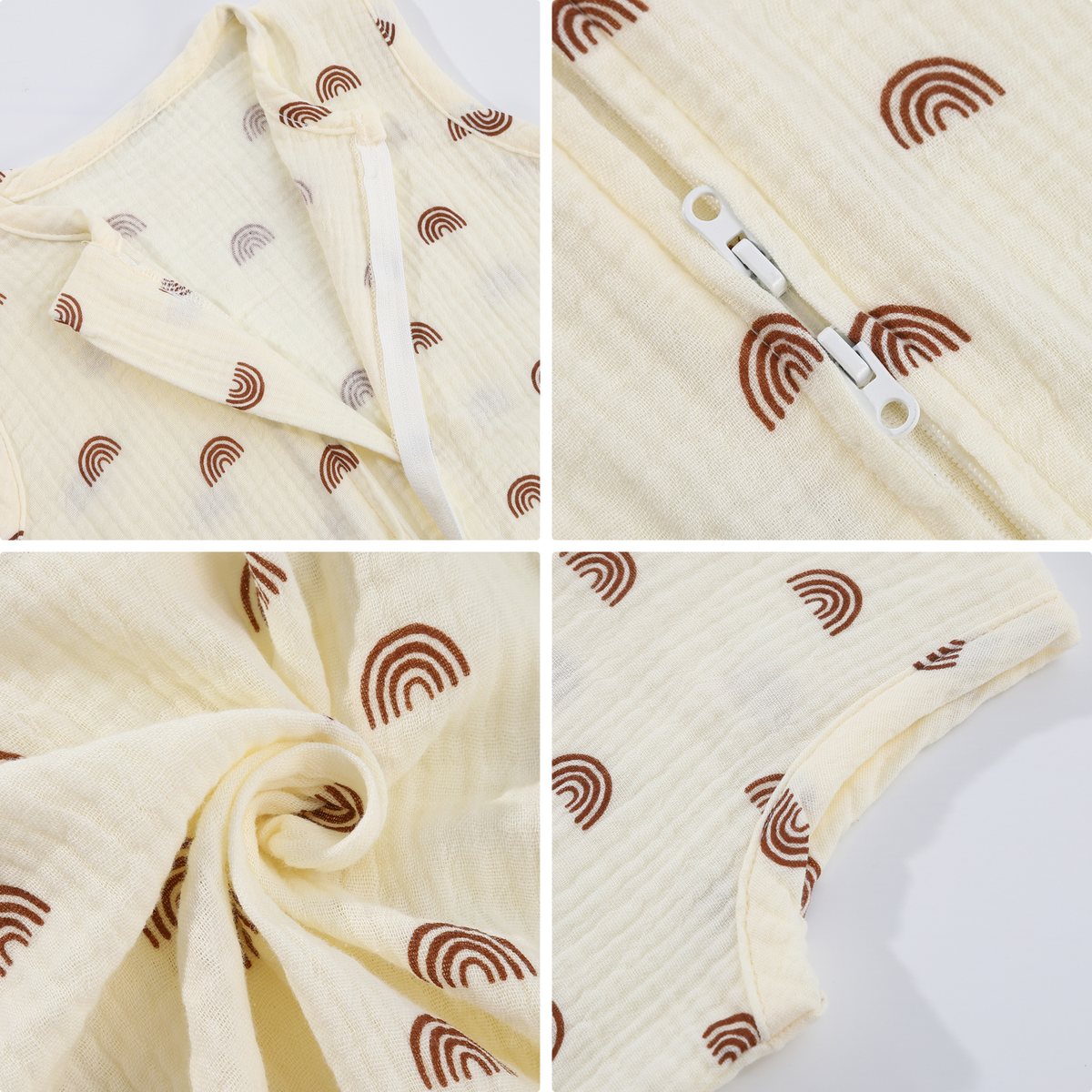
Muslin is a flat, open-weave cotton that is breathable, print-friendly and shrinks on first wash. Jersey is a knit with stretch that stays wrapped with less practice but distorts more under print. Choose muslin for print-led gifting ranges and jersey for ease-of-use positioning. This comparison is written for buyers choosing a first swaddle line under their own label.
What each one actually is
Muslin is a plain weave, usually cotton, with visible open space between the yarns. It is woven, not knitted, so it has no stretch. Jersey is a single knit, which means it stretches and recovers. That structural difference drives everything else on this page.
Side by side
| Property | Muslin | Jersey |
|---|---|---|
| Structure | Woven, no stretch | Knitted, stretches |
| Breathability | High, open weave | Moderate |
| Wrap security | Needs practice to stay tight | Stays wrapped more easily |
| Takes print well, texture visible | Print distorts when stretched | |
| Wash behaviour | Shrinks on first wash; softens | Low shrinkage; may pill |
| Edge finish | Double-fold hem or overlock; frays if weak | Cover-stitch; curls if cut badly |
| Retail story | Heritage, breathable, gifting | Practical, easy, everyday |
Why the edge is the failure point
Open-weave muslin frays. The hem is where a cheap swaddle becomes obvious after three washes: the stitching pulls, the corner distorts, and the square stops being square. A mitred corner costs more per unit and is the difference between a swaddle that survives a year and one that goes in the rag bag.
Jersey fails differently. A badly cut edge curls, and print on a stretched knit can register unevenly. Both problems are visible before the first wash, which is why a pre-production sample matters more than a spec sheet.
Shrinkage is a size decision, not a quality note
Cotton gauze shrinks. The size you sell should be the size after the first wash, so the cut size has to account for it. If the shrinkage figure is not known for the specific fabric, the honest approach is to wash-test the sample rather than assume a percentage.
Print, stretch and the mistake that costs a reprint
Stretch knit takes print differently from muslin. Jersey stretches while it is being printed, so artwork can come back at a different size than the mock-up implied. Muslin, being a flat weave, holds placement better but loses fine detail in the openness of the gauze.
The consequence is procedural: approve a strike-off on the actual fabric, at the actual repeat, and wash it. A print approved on a paper mock-up has not been approved.
How to test the difference before you commit
Order one piece of each in the same print and size, then do three things: wrap a 4 kg sandbag in each and leave it for an hour, wash both five times on the cycle you intend to print on the care label, and measure both again.
It is a crude test, but it answers the two questions buyers actually have: does it stay wrapped, and does it still measure what the label says. A lab can do it properly later; this version costs almost nothing and rules out the obviously wrong choice first.
What the choice does to your size set
A stretch knit swaddle forgives a size error: it stretches to the baby, so a single 120 cm square covers more of the newborn period. Muslin does not stretch, so the size has to be right and the post-wash size is the one that matters.
Commercially that changes the size set. A knit range can often launch in one size; a muslin range usually needs two, because the larger square is a different product to the customer even though the construction is identical. Two sizes means two cuts, and if the minimum applies per size, that is the real cost of choosing muslin.
Which one for a first order
- If your brand is about print and gifting — muslin. The texture supports the artwork and the heritage story writes itself.
- If your brand is about ease for new parents — jersey. “Stays wrapped” is a better promise than “traditional” for a first-time buyer.
- If you have one shot at a launch — muslin, in a 47 inch square, in one print. It is the most legible product in the category.
| Check | Muslin, 120 cm | Jersey, 120 cm | Your result |
|---|---|---|---|
| Stays wrapped at 0 h | Record pass / fail | Record pass / fail | |
| Stays wrapped at 1 h | Record pass / fail | Record pass / fail | |
| Size after 5 washes | Measure both sides | Measure both sides | |
| Edge condition | Hem, corners | Cover-stitch, curl | |
| Print registration | Flat weave holds it | Distorts under stretch |
One piece of each, one 4 kg sandbag, one week. The empty column is the point: this is a record you fill in, not a claim you read.
What we can put in front of you
Evidence for the points above, in the form a buyer can check rather than take on trust:
- Sandbag recordWrapped at zero and after one hour, on the actual fabric and the actual size.
- Five-wash dimensionsBoth directions, because a woven and a knit shrink differently.
- Seam cross-sectionThe mitred corner on muslin and the cover-stitch on jersey, cut open.
From the question to a quote
- 1This guide — the decision behind the question, in the abstract.
- 2Muslin swaddle blankets — the construction, fabric and size specifications it applies to.
- 3All product lines — if the programme spans more than one line in the same shipment.
- 4Request a quote or a sample — send the fabric, the size set and the expected quantity.
Sources and standards
Links go to the issuing body’s own publication. Where a rule differs by market, the market is named in the text above; nothing here is a statement that a specific product is certified.
Frequently asked questions
Is muslin warmer or cooler than jersey?
Can you print on both?
Which has the lower minimum?
Related
- Muslin swaddle blankets: specifications
- Baby blankets: fabric and use cases
- What is the MOQ for sleep sacks?
Send three things, get a real answer
Fabric or construction direction, the size set you are planning, and the quantity you expect for a first order. Approximate is fine — the point is to quote against your programme rather than against an average. If you already have a reference sample or a spec sheet, send that instead and we will work from it.